
A Consciousness Research Initiative
Coherence before Control
Applying Coherence before Control to one of humanity’s fundamental questions of consciousness: “Who am I?”
As you grow, you realize that you are not achieving your full potential. Most people respond by increasing control. Goherence proposes a different way—Coherence before Control.
Before pursuing what you want, ask whether the representation of identity from which you act is in coherence with what feels authentically yours.
Also ask whether the representation of current reality upon which you act is in coherence with what you actually encounter.
Then act and let the result provide feedback.
As you continuously refine both representations through experience, you may begin expressing more of your potential—and perhaps come closer to discovering who you truly are.
Coherence
Control
A Representation of Identity acting on a
Representation of Current Reality

You Act on Representations
To navigate life, we create representations.
They allow us to understand, decide, and act without having complete access to what they represent.
A model is one type of representation.
It stands in for something else.
The model can be useful.
But the model is not what it represents.
The same principle may apply to how we live.
Before we act, we carry some representation of identity from which we act and some representation of current reality upon which we act.
We act from a representation of identity on a representation of current reality.
These representations are necessary.
They give us a place from which to act
and something upon which to act.
We make decisions.
We pursue goals.
We create.
We build.
We change the world around us.
This is control.
Control is not the problem.
But representations can be incomplete.
They can change.
What they represent can change.
And we may not immediately notice when the two are no longer coherent.
Most of the time, we notice the consequences.
Something isn't working.
We aren't achieving what we want.
We aren't expressing our full potential.
Our natural response is often to try harder.
More effort.
More discipline.
More planning.
More optimization.
More control.
But increasing control without examining the coherence of either representation can amplify the very problem we are trying to solve.
We can become increasingly effective at moving in a direction we may no longer want to go.
Coherence before control does not ask us to stop acting.
It asks us to remain open to feedback before, during, and after we act.
Act.
Observe what happens.
Let the result provide feedback.
Reconsider either representation when necessary.
Then act again.
The process continues.
The problem is not that we act on representations. The problem begins when we increase control without first examining the representations from which we act and upon which we act.

Representation of Identity
Every action comes from somewhere.
Before we decide what we want, what we pursue, or what we create, there is already some representation of who we are.
We act from a representation of identity.
That representation may have been shaped by our body, memories, experiences, relationships, culture, roles, beliefs, and the world around us.
We may rarely question it.
We simply call it “I.”
From that “I” emerge intentions.
Intentions give direction.
Direction shapes what we pursue.
And what we pursue shapes how we act upon current reality.
But what if the representation of identity from which we act is incomplete?
What if some of it was inherited?
What if some of it was conditioned?
What if an identity that once served us no longer feels authentically ours?
Increasing control does not answer these questions.
It may simply make us more effective at pursuing what that representation of identity wants.
This is why Goherence begins upstream.
Before asking,
What do I want?
ask,
Who is the “I” that wants it?
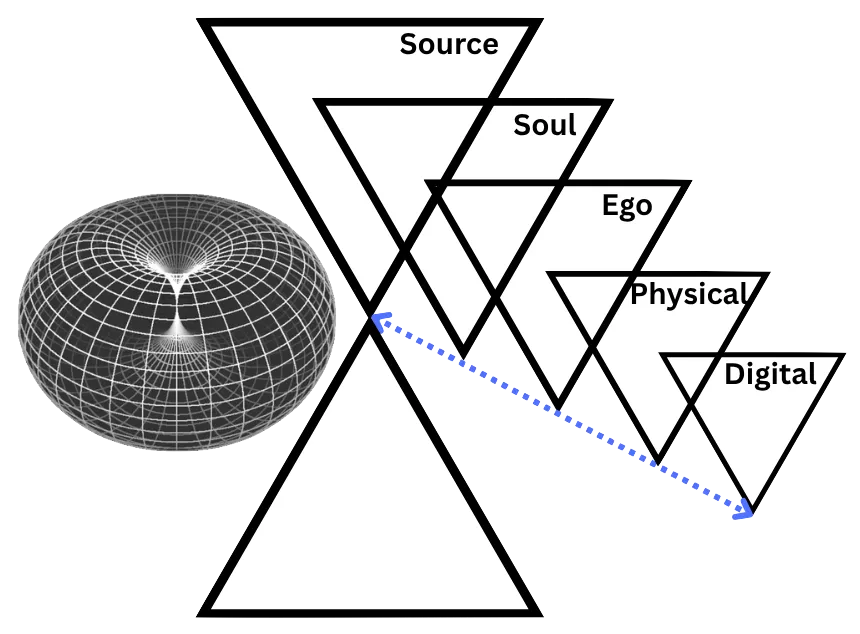
Perhaps what we call “I” can be understood through different representations.
Digital.
Physical.
Ego.
Soul.
Source.
These are not presented as final answers.
They are places from which to inquire.
Think about someone you have only encountered digitally.
Through their social media profile, photographs, messages, posts, and other digital traces, you form a representation of who that person is.
Then you meet them physically.
Suddenly, there is more.
Their presence.
Their expressions.
Their mannerisms.
The way they speak.
Things you could not perceive through their digital representation.
The digital representation was not necessarily false.
It was incomplete.
And the physical encounter doesn't necessarily complete the person either.
It simply reveals that there may be more than the representation through which you previously knew them.
Perhaps the same question can be turned toward ourselves.
Is the representation I currently call “I” all that I am?
Goherence leaves that question open.
As we act, experience, and receive feedback, some representations may feel increasingly coherent and authentically ours, while others may begin to fall away.
The purpose is not to choose an identity because someone tells us it is true.
It is to keep questioning the representation from which we act.
As the representation of identity becomes more coherent, we may come closer to discovering who we truly are.

Representation of Current Reality
Every action happens somewhere.
Before we decide what to do, how to respond, or what to change, there is already some representation of the current reality upon which we are acting.
We act upon a representation of current reality.
That representation may be shaped by our senses, memories, experiences, beliefs, emotions, conversations, information, measurements, and increasingly, digital systems.
We need these representations.
We cannot perceive everything that is happening around us.
We notice some things.
We miss others.
Consider a simple experience many of us have had.
You start thinking about buying a particular car. Suddenly, you begin noticing that exact brand, model, or even color everywhere you go.
It can almost seem as though there are suddenly more of those cars on the road.
But the cars may have been there all along.
What changed was not necessarily current reality.
What changed was what you noticed—and therefore your representation of current reality.
We interpret what we notice.
And from that understanding, we act.
But current reality never stands still.
Circumstances change.
Other people change.
New information arrives.
We change.
What was true yesterday may not be true today.
And yet the representation upon which we act may remain unchanged.
Reality is constantly giving us an opportunity to notice this.
Through what happens.
Through what works.
Through what doesn't.
Through consequences we expected.
And consequences we didn't.
This is feedback from current reality.
But we don't always allow that feedback to change our representation.
We may ignore the signal.
We may defend our assumptions.
We may explain away the outcome.
Or we may simply try harder.
The representation remains unchanged while control increases.
Coherence requires a different response.
When what we encounter challenges our representation, allow the representation itself to be questioned.
What did I misunderstand?
What has changed?
What am I no longer seeing clearly?
What might I be assuming that is no longer true?
The purpose is not to create a perfect
representation of current reality.
That may never be possible.
It is to keep the representation upon which we act open to correction by what we actually encounter.
Before increasing control, ask whether the representation of current reality upon which you act remains coherent with what is actually happening now.
How Goherence Helps You Explore “Who am I?”
Goherence approaches “Who am I?” not as a question that must be answered before you begin living, but as an inquiry that can unfold through life itself.
Every day, we act from a representation of identity upon a representation of current reality.
Most of the time, we simply act without being conscious of either.
Goherence proposes a different approach: become conscious of the representations from which you act and upon which you act.
What representation of identity am I acting from?
What representation of current reality am I acting upon?
Then act.
Observe what happens.
Let the result provide feedback.
And remain open to what that feedback may reveal about either representation.
Over time, this continuing inquiry may deepen our understanding of both the reality we encounter and the identity we call “I.”
Goherence explores this through three systems.

System of Representations
Become conscious that you act on representations.
We need representations to live.
They allow us to understand, decide, and act without having complete access to everything they represent.
But as we move through life, we can easily forget that they are representations.
A representation of identity can simply feel like “me.”
A representation of current reality can simply feel like “what is.”
When that happens, there may be little space to question either one.
The System of Representations begins with awareness.
Throughout the day, notice the representations involved in your actions.
What representation of identity am I acting from?
What representation of current reality am I acting upon?
You don't need to assume that either representation is wrong.
Nor do you need perfect representations before you act.
Choose.
Create.
Build.
Work.
Relate.
Experiment.
Engage with life.
Action itself becomes part of the inquiry.
Act.
Observe what happens.
Receive feedback.
And remain open to what either representation may not yet contain.
The purpose is not to stop acting.
It is to remember that the representation is not necessarily what it represents.
The System of Representations helps you remain conscious of the representations from which you act and upon which you act.

System of Identity
Become conscious of the representation of identity from which you act.
Throughout the day, there is an “I” behind what you choose, pursue, avoid, create, and become.
Most of the time, we simply act from that “I” without questioning it.
But the representation of identity we call “I” may have been shaped by family, culture, expectations, comparison, circumstance, memories, experiences, and beliefs.
Some of it may feel authentically ours.
Some of it may have been inherited.
Some of it may once have served us but no longer does.
The System of Identity invites you to become conscious of that representation as you move through life.
Who is the “I” acting right now?
What feels genuinely mine?
What am I pursuing because I truly want it?
What might I be pursuing because I learned that I should?
What feels deeply worth expressing through my life?
You don't need the final answer to “Who am I?”
Begin with the representation of identity from which you are acting now.
Act.
Observe.
Notice what feels increasingly authentic and coherent.
Notice what creates persistent inner friction.
Remain open to what your experience may reveal.
Sometimes the representation may become more coherent.
Sometimes an identity that once felt like “me” may begin to feel incomplete.
And sometimes the inquiry may open into a deeper question: If this is a representation of who I am, what does it represent?
The purpose is not to arrive quickly at another identity and hold onto it.
It is to remain conscious of the representation from which you act while continuing the inquiry into what lies behind it.
The System of Identity helps you explore whether the identity from which you act feels increasingly coherent, authentically yours, and perhaps closer to who you truly are.

System of Current Reality
Become conscious of the representation of current reality upon which you act.
Throughout the day, we carry an understanding of what is happening around us.
What other people mean.
What circumstances allow.
What opportunities exist.
What is working.
What is not.
Most of the time, we simply act upon that understanding without questioning it.
But our representation of current reality may be shaped by what we notice, what we remember, what we believe, what we expect, and what we may be missing.
The System of Current Reality invites you to become conscious of that representation as you move through life.
What do I believe is true right now?
What am I assuming?
What do I actually know?
What might have changed?
What might I not be seeing?
Then engage with life.
Talk to the person.
Look at the evidence.
Try the experiment.
Take the action.
Let current reality speak back.
Pay attention to what happens.
What works?
What doesn't?
What did you expect?
What surprised you?
The result does not automatically tell you what is true.
But it gives you feedback with which to question and refine the representation upon which you acted.
Sometimes your understanding of current reality may become more coherent.
Sometimes you may discover that an assumption was incomplete.
And sometimes the feedback may travel deeper, causing you to reconsider the representation of identity from which you acted.
The purpose is not to achieve a perfect representation of current reality.
It is to remain open to correction by what you actually encounter.
The System of Current Reality helps you keep the representation upon which you act increasingly coherent with what is actually happening now.
Goherence doesn't claim to answer “Who am I?” for you. It creates a space to explore the question through conscious awareness of the representations from which you act and upon which you act, action, feedback, and continued inquiry.

Join the Goherence Community
This isn't a community built around having the answers.
It's a community built around the inquiry.
Each of us experiences life from a different perspective.
We act from different representations of identity.
We act upon different representations of current reality.
We notice different things.
We make different assumptions.
We take different actions.
And life gives each of us different feedback.
Through those experiences, each of us may discover something the rest of us haven't seen.
Goherence creates a place to bring those discoveries together.
Share an experience.
Question an assumption.
Explore an idea.
Challenge a representation.
Connect insights from consciousness, philosophy, science, technology, business, spirituality, or simply everyday life.
Think of it as researchers comparing notes.
What are you discovering?
What keeps appearing?
What doesn't fit?
What changed when you became conscious of the representation from which you were acting?
What changed when you questioned the representation of current reality upon which you were acting?
What happens when you apply Coherence before Control?
No one person's experience gives us the whole picture.
But another person's experience may reveal something our own representation does not contain.
By sharing what we observe, questioning what we think we know, and remaining open to what we encounter, perhaps we can see more together than any of us could see alone.
The inquiry is ongoing. Come share your notes.

Contact
© Copyright 2026 Goherence. All rights reserved